


The short answer: two quotes for "the same website" can range from €1,500 to €15,000 because they do not describe the same work. The price of a website is first of all time: a few days on a proven base on one side, several weeks on the other, often with the same team, which simply has the time to finish the details. On a screenshot, the difference barely shows. It shows when the site is in use: on a phone, in Google, when you need to edit it, and three years later. The prices quoted were checked on 13 October 2026.
Spider-Man in 10 minutes, 1 minute, 10 seconds
You may have seen this viral video: illustrator Mo Selim draws Spider-Man three times, in ten minutes, in one minute, then in ten seconds (the original video). Same artist, same marker, same subject. In ten minutes, you get a detailed face, the web drawn strand by strand, the shading and the eyes. In one minute, a recognisable outline in a few strokes. In ten seconds, a scribble that makes you laugh. Picked up in memes all over the world, the video passed 30 million views according to its author.
The talent is the same in all three boxes. Only the time changes, and that is what makes all the difference.
A website works exactly the same way. The same team can often deliver a site in a few days or in a few weeks. On the screenshot sent with the quote, both have a logo, a menu, a nice photo and a "Contact" button. The difference shows in what the time allowed to be refined, and that time is what you pay for.
Same brief, different car
Cars show the other side of the gap. Give the same brief to five carmakers: four wheels, five seats, get from Brussels to Liège. You will receive a Lada, a Renault, an Audi, a Mercedes and a Lamborghini. They all drive, they all take you to Liège, and nobody expects to pay the same price for them.
What separates them is not in the brief: the finish of the seats, the noise at 120 km/h, the grip in the rain, the electronics that do not fail, the way the car ages and what it is worth when you sell it. A good part of the gap comes from the time spent getting every detail right, on the drawing board as in the factory.
A website follows the same logic. The brief "five pages and a contact form" says nothing about the finish. A Solo website is a reliable, well-finished city car, designed for a specific use. A Business or Premium website is closer to the high-end saloon: more hours on every part, more options, and a durability that is paid for upfront. The right choice depends on the road you have to travel.
What you really pay for: time for the details
A website is not bought like an object off the shelf. What costs is the time spent on your project. From one level to the next, it is often the same team at work; what changes is the time it has to finish the details: proofreading every text, testing every screen, reworking a page that works but could be more convincing. That is also what our price simulator shows: move the slider, and at each step you see what the budget really buys.
| Budget (excl. VAT) | Working time | What that time allows |
|---|---|---|
| From €1,500 (Solo) | A few days, on a proven base | Up to 5 pages built with AI, framed and reviewed by a designer, live within ten working days |
| €5,000 (Start) | About 8 days | More pages, news, 2 to 3 feedback rounds to refine the design |
| €12,000 (Business) | About 20 days | A custom Wagtail website, 8 page templates designed for you, multilingual, every screen tested and adjusted |
| €20,000 (Premium) | More than 30 days | 10 to 12 page templates, design direction pushed further, connection to your CRM or business software |
| €35,000 (Growth) | More than 55 days over the year | The Premium website and twelve months of SEO: keywords, editorial plan, twenty optimised pieces of content |
Read like this, the tenfold gap is no longer a mystery. A €1,500 site and a €15,000 site are not two prices for the same thing; they are two different amounts of work.
A concrete example: Marc, an electrician, asks for "a 5-page website"
Marc is a self-employed electrician. He sends the same request to four providers: "a five-page website, home, services, projects, about, contact". He gets four proposals that seem to talk about the same site.
Proposal 1: "free website", €39 a month for four years
A generic template, filled with his texts by an operator who builds several sites a day. Nothing to pay upfront, but a 48-month contract, €1,872 in total, and a site that remains the provider's property. The day Marc wants to leave, he starts from scratch. It is the only one of the four where the money can be lost, and we explain why in our article on cheap websites.
Proposal 2: €1,500, a proven base and a designer
The five pages are built with AI from an already tested base, then a designer adapts them to Marc's identity and reviews them before launch. One round of corrections, no subscription afterwards, and Marc adds a job photo by asking his AI assistant. The site belongs to him. For a self-employed person who has to reassure before the first call, it is often the right choice: it is our Solo package.
Proposal 3: €5,000, a full showcase website
More pages, one per service if Marc also does solar panels and EV chargers, a news section, two to three feedback rounds on the design, the SEO basics set up for each service. The site starts bringing in clients from Google, instead of only reassuring those who already know him.
Proposal 4: €12,000, a custom website
A designer draws the pages around what makes Marc's clients call, a developer builds the site on a full CMS, a project lead keeps the schedule. The site is multilingual if Marc also works in Flanders, it has a jobs page for hiring, and it is designed to grow with the business without being rebuilt in three years.
All four proposals are honest. They simply do not meet the same need, and the right one depends on what the site has to do for Marc: exist, reassure, attract, or carry a growing business.
What really drives the price
When two quotes do not look alike, the difference almost always sits in these items. The number of pages matters little: on a CMS, adding a page costs nothing.
- The depth of the site: how many page templates are designed for you (a "service page", a "project page", an "article"), how many languages, how many connections to your tools.
- Quality and care in the details: a design adapted from a template or drawn for your business, cropped photos, proofread texts, a site tested on every screen before launch.
- Strategy: did anyone ask what your clients are looking for, what makes them hesitate and what makes them call? That is what separates a nice site from a website that converts.
- SEO: the technical basics set up from the design stage, or a real presence worked on month after month.
- Guidance and follow-up: a walkthrough at delivery, someone who answers in two years, security updates, someone checking whether the site brings in enquiries.
- What the site costs after the first year: a monthly rent for years, or hosting with no subscription. Over five years, this item sometimes flips the comparison.
It is all in the details: experience means the mistakes you avoid
On screen, a site built in three days can look as good as one built in three weeks. The difference hides in what nobody looks at until it breaks. Since 2012 and more than a hundred websites delivered, we have seen the same mistakes come back, and an experienced provider avoids them without you even knowing.
- The form that lands in spam: the site seems to work, but enquiries never arrive. We test real sending and set up enquiry tracking at delivery.
- The redesign that disappears from Google: old addresses are not redirected, and years of rankings vanish within weeks. We redirect every old page, following our migration method.
- The domain name in the provider's name: the day you want to leave, your own address does not belong to you.
- The site that is slow on a phone: photos of several megabytes, invisible on a desktop screen, keep the 4G visitor waiting until they leave.
- The site you can no longer edit: everything is frozen in the code, and changing opening hours means calling someone.
- Forgotten updates: a plugin that was never updated becomes, two years later, the way in for a hack.
- The decorative cookie banner: it shows, but the analytics tools load anyway before any consent, which the GDPR forbids.
None of these mistakes shows on launch day. A site can therefore look good on the surface and turn out expensive later, and experience is mostly knowing where to look.
Fast, cheap, good: pick two
Project managers have known this triangle for a long time: a project can be fast, cheap or good, and it is never all three at once.
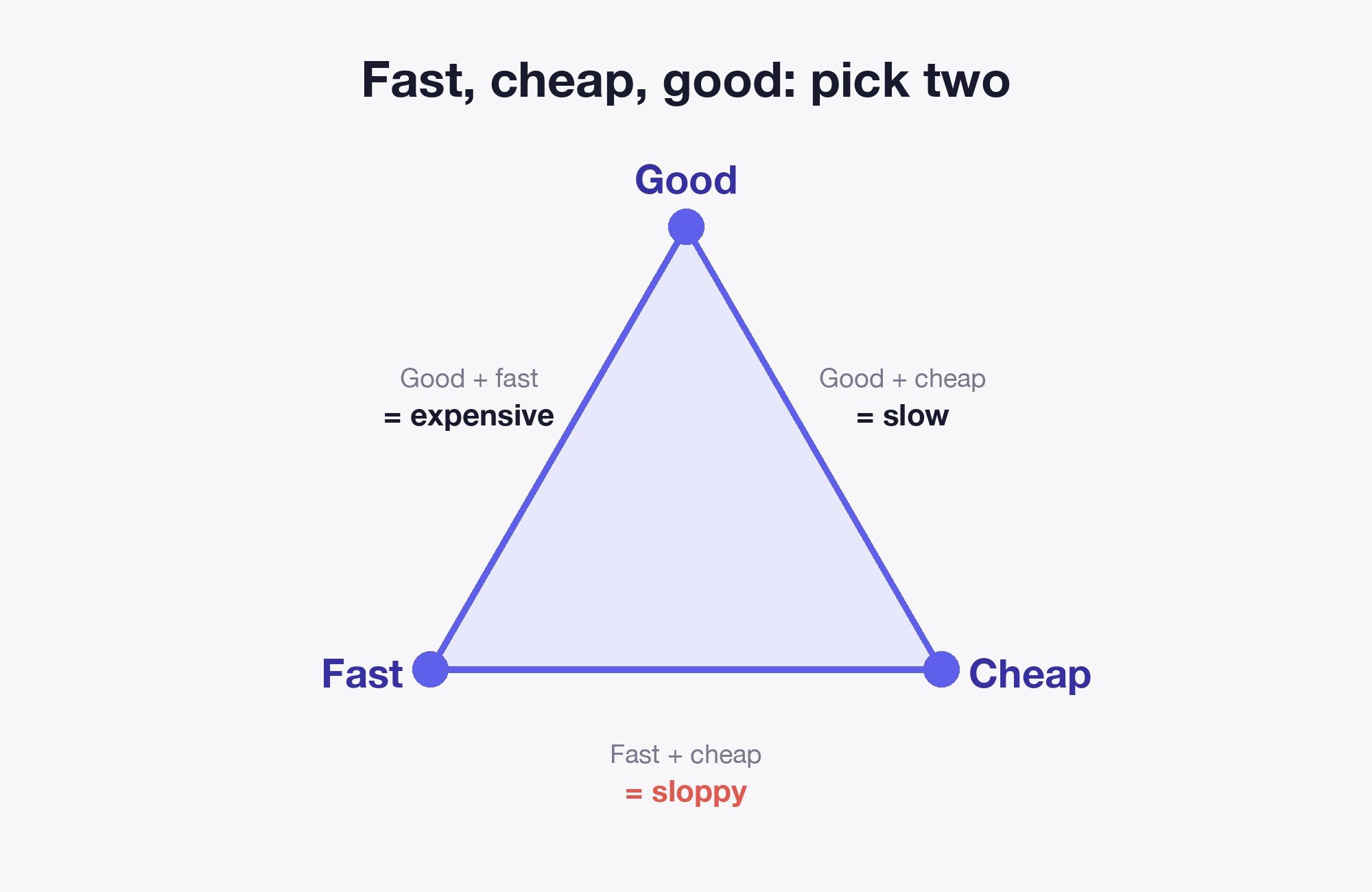
- Fast and good: you need more people at the same time, so it is expensive.
- Good and cheap: it takes time, the project fits in between two others, so it is slow.
- Fast and cheap: steps get skipped, so it is sloppy.
Our packages are deliberate positions on this triangle. Solo is fast and affordable because its scope is closed: five pages at most, a proven base, one round of corrections. Quality holds because we do less, with the same care. Business and Premium bet on quality and depth, and time and budget follow. Be wary of the quote that promises all three: something has been sacrificed, and you will find out later.
What you do not pay upfront, you pay later
In a custom project, every choice has a cost, and so does every saving. When the budget or the deadline is not enough, the team makes sacrifices: one page template fewer, content hard-coded instead of editable, a feature added in a rush, tests skipped. The site ships on time and on budget. The difference is set aside as debt.
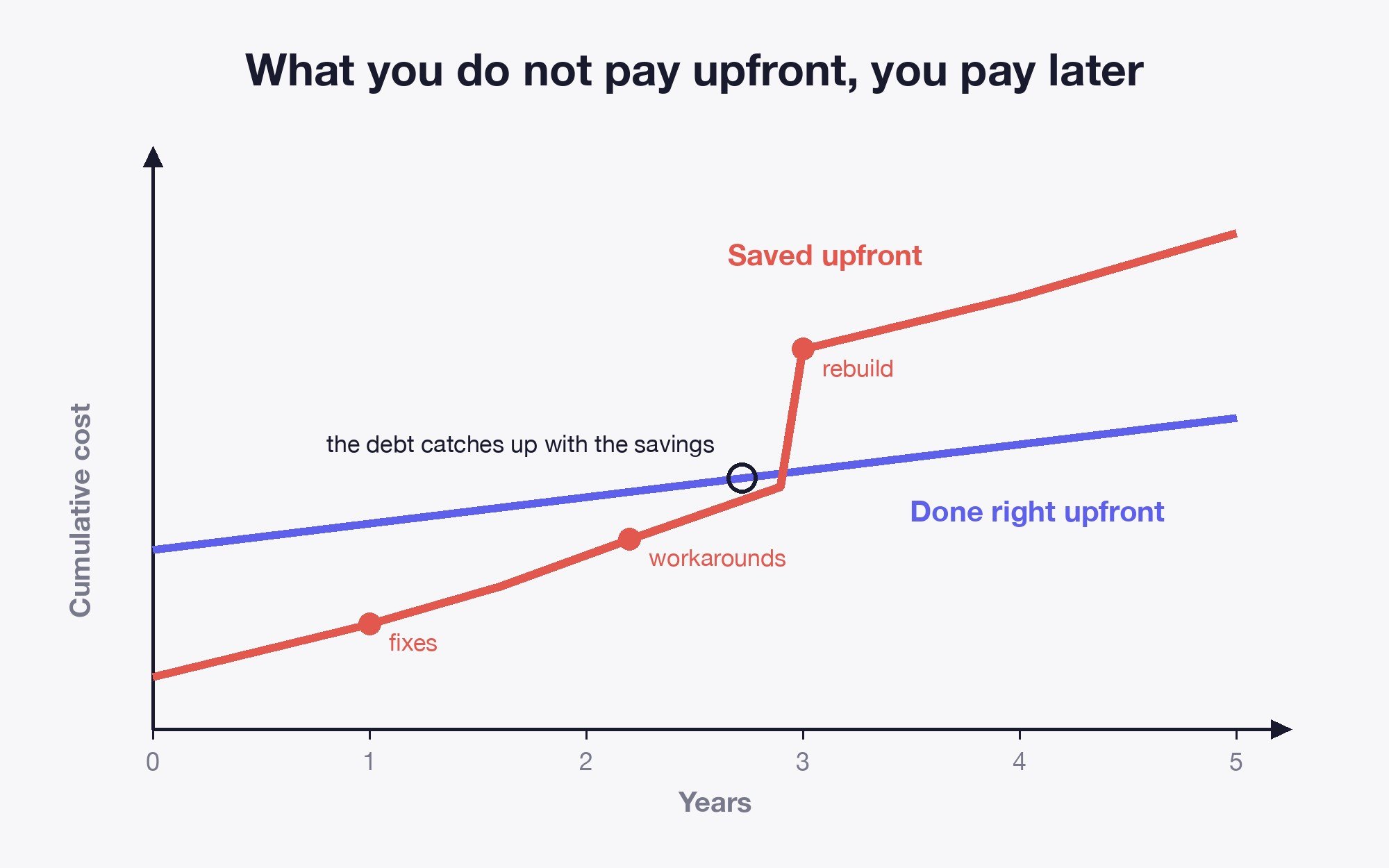
Developers call it technical debt, and it is repaid with interest. Every change takes longer because the early shortcuts have to be worked around, and a simple update turns into a small project. After three or four years, when the workarounds cost more than starting over, the rebuild comes: you pay for the site a second time.
Taking on debt can be the right call. Launching a modest site quickly to test a business is a sound decision, as long as it is made knowingly. The problem is the debt nobody told you about. Ask your provider what was simplified to stay within budget, and what it will cost to add it later.
What about maintenance? Your website needs it, like your car
Some providers will tell you that a website, once online, needs nothing more. Others will talk to you frankly about maintenance. Your car gets serviced, so does your boiler, and nobody finds that surprising. A website has the same need, with one misleading difference: when it breaks down, it makes no noise.
| What gets maintained | If you forget it | |
|---|---|---|
| Your car | Oil change, tyres, brakes, roadworthiness test | A breakdown on the motorway, a failed inspection |
| Your boiler | Cleaning, tuning, safety check | A rising bill, a breakdown in the middle of winter |
| Your website | Security updates, backups, HTTPS certificate, tested forms | A hack, enquiries that stop arriving, a drop in Google |
In practice, website maintenance covers:
- Security updates: the CMS, its plugins and the server receive fixes several times a year. A site that is never updated ends up hacked or broken.
- Backups and the HTTPS certificate: renewed and checked, so you can roll back the day something breaks.
- Browsers and phones that change: a site that is perfect today can display badly on the next phone or the next browser version.
- Forms and links: a form that no longer sends, a link to a partner that has disappeared, a map that no longer shows.
- SEO: Google changes its rules, your competitors move forward, and a site that stands still slowly slips back.
What maintenance costs depends on the technology. A static site, like those of our Solo and Start packages with the AI CMS, has very few moving parts: no database and no plugins to update, which lets us charge no subscription. A site on a full CMS like Wagtail needs regular updates, and that is the job of managed hosting: €65 excl. VAT per month for a small Start site on Wagtail, priced in the quote for Business and Premium.
Be wary of both extremes: the quote that plans no maintenance for a site that needs it, and the monthly subscription that charges for maintenance without ever saying what it includes. Ask what is done, how often, and what happens when something breaks.
How to see the difference before you sign
The three-metre test does not work on a quote: you have to get closer. Ask every provider these questions, and compare the answers rather than the amounts.
- How many days of work are planned, and by whom?
- Is the design drawn for me or adapted from a template? How many feedback rounds?
- Who owns the site, and what happens if I change provider?
- How much does the site cost each year after delivery, and how long am I committed?
- How do I change a text or a photo myself?
- Who writes the texts, and what happens to my Google rankings if I rebuild an existing site?
- Who maintains the site, and what does maintenance include?
- Who answers me in two years?
A serious provider answers each one plainly, whatever their price. Vagueness about ownership or commitment length is the clearest sign that a cheap quote will end up costing more.
Estimate your budget in two minutes
Three tools to go from "how much does it cost?" to "how much does it cost for me?":
- The price simulator shows what each budget step buys in working time and results.
- The calculator starts from your project (pages, languages, features) to give a range.
- The return calculator tells you how many clients you need to sign to pay back the site, with your own figures.
For Belgian market ranges, package by package, read how much a professional website costs in Belgium. And if your company is in Brussels, the Prime Digitalisation grant can cover 25 to 70% of eligible expenses.